

Institution search
Information Technology Industrial Research Institute
The Telecommunication Industry Research Institute operated in a specific and well-defined period of Hungarian industry, its task was the research, development, testing and, to a certain extent, the experimental production of discrete active and passive electronic components, and later of various integrated circuits, in terms of construction, technology and measurement technology.
The main task of HIKI was to develop the component base of the telecommunications/electronics industry. The aim of establishing the new institute was to centralize the previously isolated research in this fastest-growing industrial area worldwide, to unite the previously scattered forces, and to rely on the traditions adopted from incandescent lamp and electron tube research, so that the domestic industry could keep pace with the developments taking place abroad. The institute was an active participant in two major revolutions in the development of electronics: the emergence and rapid spread of semiconductor technology in the mid-1950s and microelectronics from the mid-1960s.
- Frigyes Kőműves, director, 1953-1965
- Aurél Komporday, director 1965-1977
- Ivan Nemeskeri, director 1977-1981
Due to the extreme complexity of the development of the microprocessor through so-called reverse engineering, it was necessary to concentrate all domestic forces, so in 1976 the “LSI Research and Development Association” was established, which was the joint work of four research institutes — HIKI, TKI, KFKI, MFKI— and was an experiment of scientific value in its own right. The goal of LSI KFT was to develop some highly complex integrated circuits (a modern microprocessor, p- and n-channel silicon gate ROM, programmable fixed memory and a RAM memory circuit each). This joint research work was new in both its content and form, and this collaboration was a rare success in itself, in a domestic public life prone to disunity. Aurél Komporday played a decisive role in its creation. Within the framework of the division of labor, HIKI was tasked with developing silicon wafer technology, creating certain technological equipment, so-called mask making, and developing the necessary special, high-purity infrastructure, and localizing the new culture. This was the purpose of the “ Microelectronics Technologies” study series launched at the initiative of Ákos Herman.
The work was outstanding in deciphering the microprocessor codenamed "i8080", in which Zoltán Simon and Péter Keresztes excelled.
The research departments of the institute were divided into four main departments called “laboratories” in the 1960s:
- light source design and technology, materials science (Mo, W, Al 2 O 3 ), and design and technology of semiconductor devices, leader: György Szigeti;
- transmitter tube construction and technology, leader: István Koncz;
- construction and technology of passive components (R, C, potentiometer), leader: János Katona
- vacuum tube application technology/electronic developments, instrument and measurement technology, manager: Iván Péter Valkó.

The transformation of the organization took place in several steps, and by the mid-1970s the following departments were established:
- semiconductor department, headed by Iván Szép, then after his departure to the position of deputy scientific director of the Hungarian Academy of Sciences, János Egri, later László Ugray, and Tamás Strausz;
- Department of Electronics, headed by Iván Péter Valkó, and György Hidas following his becoming a university professor at BME and the repatriation of Ferenc Fischer to the Federal Republic of Germany;
- thin film development department, led by Tamás Strausz, later by Róbertné Ligeti,
- experimental manufacturing department, which included the design of hybrid integrated circuits and the development of thick-film technology, under the direction of Deputy Director György Wollitzer,
- Instrument and Measurement Technology Department, István Till, Head of Department,
- Reliability Testing Department, Head of Department Ferenc Bráda,
- Technological Equipment Development and Experimental Production Department, Deputy Director Iván Nemeskéri,
- Telecommunication Standardization Center, initially led by Tibor Nádas and then by Pál Varga.
The company ceased to exist in 1981.
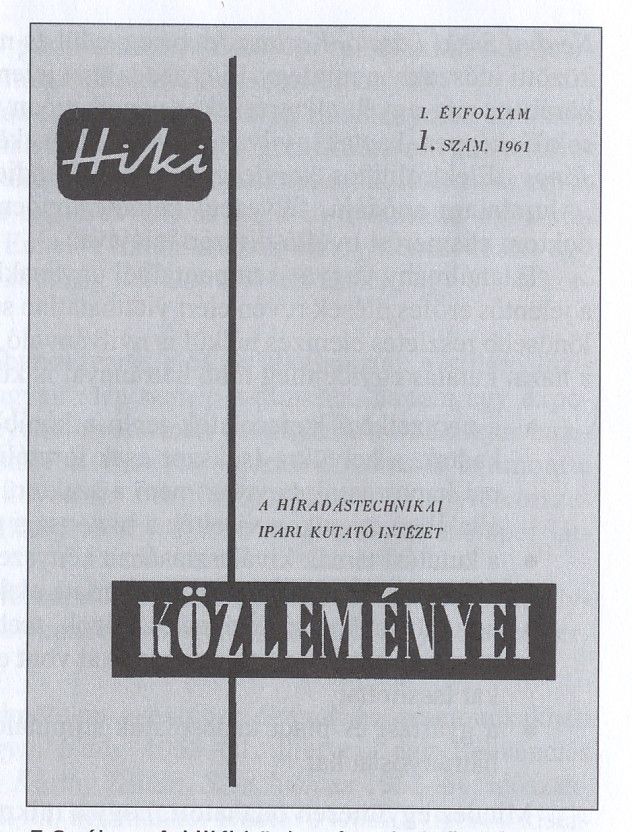
In the early 1960s, in order to make the results public,George the Cutterinitiated and edited by, theHIKI Announcementsc. journal, which published the results of researchers for nearly two decades, at a time when publishing abroad encountered great difficulties.

The institute's professional achievements became recognized both domestically and internationally, while HIKI gradually became the third largest scientific research institute in the country (after the Hungarian Academy of Sciences ( MTA) KFKI and the Hungarian Institute of Technology (TKI )) with a staff of 1,200 (1970s), which was also characterized by its economic strength, e.g. it expanded the Fóti-úti site with new buildings on its own, which enabled the institute to be located more centrally.
The institute organized a scientific session for the 20th anniversary of its existence, the details of which can be found in the document entitled 20th Anniversary of the Information Technology Industrial Research Institute, available in the Sources section.
Created: 2019.12.22. 20:24
Last modified: 2025.04.18. 13:52